
About MCSA
How MCSA Came About
MCSA grew from questions about participation, recognition, and whose knowledge is valued in science.
Section 02
The Problem
Migrants can bring education, professional expertise, lived experience, cultural knowledge, languages and other forms of knowledge. Yet their knowledge and expertise are not always recognized.
“Migrant knowledge and expertise are not always recognized.”
This raised a broader research question that runs through MCSA’s work:
Who gets to participate in producing knowledge?
Section 03
The Questions
From that problem, a set of questions emerged. They are presented here as they appear in MCSA’s own materials.
Who participates in research?
Who asks the questions?
Whose knowledge is recognized?
Who gets to contribute to the production of knowledge?
Who is recognized for that contribution?
Section 04
Looking at How Knowledge Is Produced
These questions also require attention to the structures and traditions through which scientific knowledge is produced and recognized. MCSA’s work pays critical attention to the androcentric, Western-centered and Eurocentric traditions that have shaped scientific knowledge and institutions, and to questions of gender, power, marginalization and whose perspectives are recognized.
These are not newly invented terms. They reflect a critical perspective already present in MCSA’s materials, and they are shown here as multiple perspectives rather than a hierarchy.
Multiple perspectives arranged around a shared center: androcentric traditions; Western-centered and Eurocentric traditions; gender; power; marginalization; representation; and whose perspectives are recognized. None is placed above another.
Section 05
A Different Way to Think About Participation
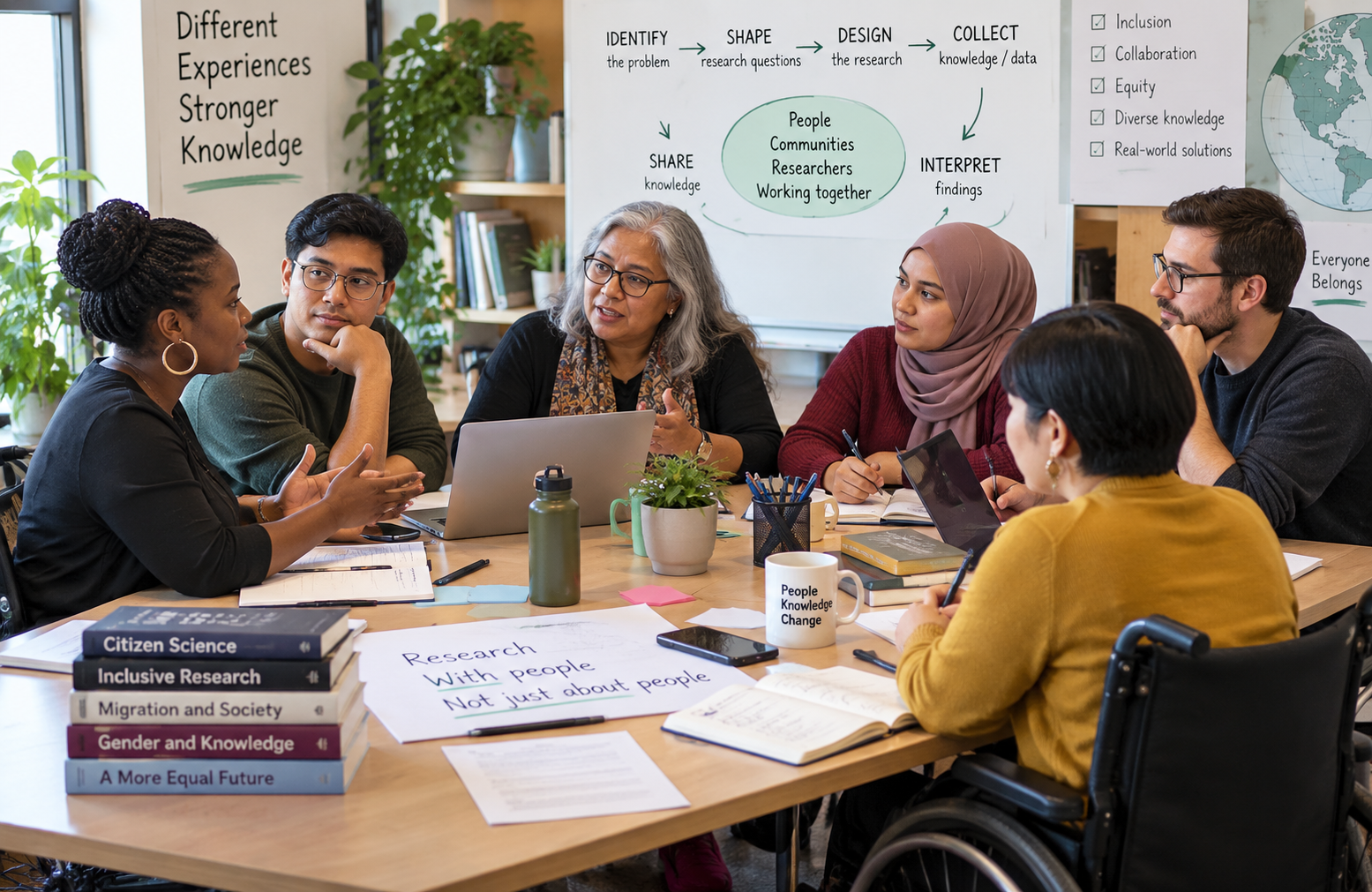
Citizen science can involve people who are not professional scientists in research. Depending on the approach and project, participation can extend into different parts of the research process.
A visual research pathway showing six stages in sequence: identify the problem; shape research questions; design research; participate in generating knowledge or data; interpret findings; and share knowledge. Different citizen science approaches involve participants in different parts of this process.
Different citizen science approaches involve participants in different parts of the research process.
Section 06
When Participation Goes Further
Some participatory and co-created approaches provide opportunities for participants to contribute to decisions about research, rather than only providing information or data. This connects directly to MCSA’s central question:
“How can migrants participate not only in research, but in shaping the knowledge that research produces?”
Section 07
A Possibility Became Clearer
Engagement with responsible Open Science and citizen science, including learning from the ROSiE project, helped make visible the possibilities of participation, co-creation, ethics, recognition and responsibility within research.
ROSiE is presented here as an important reference and learning experience. It is not described as the origin of MCSA, and no organizational relationship beyond MCSA’s documented contribution is implied.
Section 08
From Questions to an Approach
The thinking developed in stages: from a problem, to questions, to a critical examination of how knowledge is produced, to citizen science as a possible pathway, to participatory and co-created approaches, and toward MCSA.
A visual progression from the problem to the approach, shown in sequence: the problem; the questions; critical perspectives; citizen science; participatory approaches; and MCSA as the final, stronger node.
MCSA was established in Norway in 2023 as a migrant-led organization. It was formed to strengthen the participation of migrants in citizen science and to question whose knowledge is recognized in the production of science — including the Eurocentric, Western-centered and androcentric traditions that have shaped scientific knowledge and institutions.
MCSA brings together migrants, citizen scientists, researchers and community organizations to co-produce knowledge, with particular attention to migrant women and gender minorities, and to the structural inequalities that can limit participation in research and public life.
- Registered address
- Hanserudveien 73536 Noresund, Norway
- Registration
- PIC: 875866157VAT: 931566601MVA
Section 09
MCSA Today
This thinking has developed into MCSA’s work. The areas below are supported by approved MCSA content and are described as work, not as documented impacts.
A network of MCSA’s existing areas of work arranged around a central MCSA node: citizen science; research; knowledge production; participation; collaboration; advocacy; and public engagement.
Closing statement
“MCSA asks not only how migrants can participate in science, but how research can make space for migrants and other underrepresented people to contribute to the production of knowledge.”
“The questions that shaped MCSA continue to guide how we think about citizen science, participation, knowledge, and inclusion.”
Three Ways to Go Further
Work hand-in-hand with MCSA
Let us work together to change how science includes the people it concerns. Let science, society and the rest hear our voices.